
LASIK & Refractive Care in Gurgaon
Explore Clearer Vision Beyond Glasses & Contact Lenses
Detailed refractive evaluation and personalised guidance for LASIK and other vision-correction options based on prescription, corneal health, lifestyle and visual goals.

Detailed Refractive Check
Prescription & eye health
MBBS, MS Ophthalmology
Experienced eye specialist
Detailed Eye Evaluation
Diagnosis before treatment
Gurgaon Practice
Sohna Road & Sector 41
Eye Treatments
Thinking About LASIK?
Suitability cannot be decided by prescription alone. A complete eye and corneal evaluation is needed.
Advanced LASIK Care in Gurgaon
LASIK & Vision Correction in Gurgaon
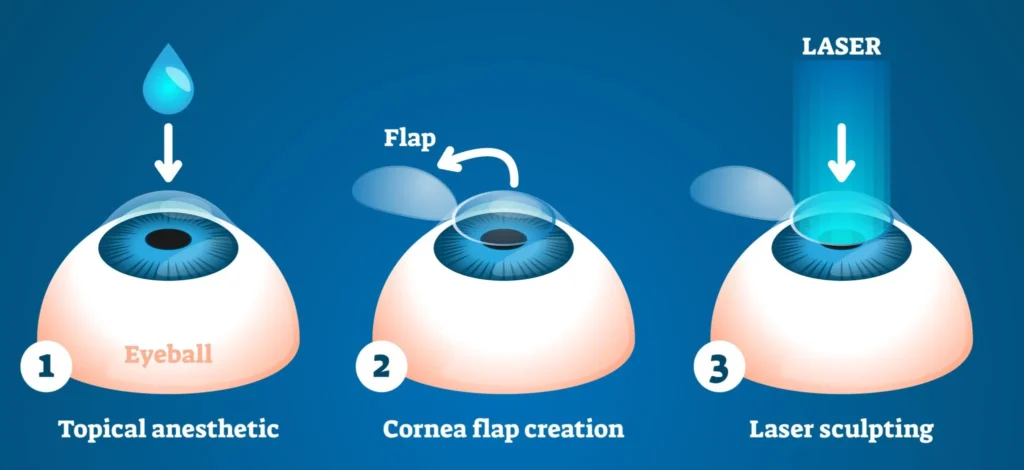
LASIK reshapes the cornea so light can focus more accurately on the retina. It may be used in suitable cases of myopia, hyperopia and astigmatism to reduce dependence on spectacles or contact lenses.
LASIK is elective surgery and is not suitable for everyone. A detailed preoperative evaluation helps determine whether LASIK, another refractive procedure, or continued use of glasses or contact lenses is more appropriate.
Important: LASIK can reduce dependence on glasses, but it does not guarantee perfect vision or permanent freedom from spectacles.
Which Vision Problems Can LASIK Correct?
Myopia
Nearsightedness causes distant objects to appear blurry.
Hyperopia
Farsightedness can affect near and sometimes distance vision.
Astigmatism
An irregular corneal shape can cause blurred or distorted vision.
Presbyopia
Colours may appear less vivid, washed out or slightly yellowed.
Who May Be Suitable for LASIK?
- Usually 18 years or older
- Healthy cornea
- Treatable refractive error
- Realistic expectations
- Stable spectacle prescription
- Adequate corneal thickness
- No significant active eye disease
- Suitable overall eye health
When LASIK May Not Be Suitable
- Unstable prescription
- Keratoconus or ectasia
- Corneal scars or disease
- Visually significant cataract
- Very thin cornea
- Severe dry eye
- Advanced glaucoma
- Poorly controlled diabetes
Pre-LASIK Evaluation
01
Vision & Refraction
Current prescription and best-corrected vision are measured.
02
Corneal Topography
Corneal shape is mapped to screen for irregularities.
03
Corneal Thickness
Pachymetry helps assess whether adequate tissue is available.
04
Dry Eye Assessment
The tear film and ocular surface are checked before surgery.
04
Pupil & Eye Health
The cornea, lens, retina and optic nerve are evaluated.
04
Lifestyle Discussion
Work, sports and visual expectations help guide planning.
Refractive Treatment Options
1. LASIK
LASIK reshapes the cornea using a laser to improve focus and reduce dependence on glasses or contact lenses. It may be suitable for selected patients with myopia, hyperopia or astigmatism.
2. PRK / Surface Ablation
PRK is a laser vision correction procedure performed without creating a corneal flap. It may be considered for selected patients, including some with thinner corneas.
3. SMILE
SMILE is a minimally invasive procedure performed through a small corneal incision. It may be suitable for selected patients with certain refractive errors.
4. Phakic IOL / ICL
Phakic IOL or ICL involves placing a specially designed lens inside the eye. It may be considered for patients who are not suitable for corneal laser procedures.
Recovery After LASIK
Many patients notice visual improvement relatively quickly, but vision can fluctuate during early healing. Temporary dryness, scratchiness, burning or sensitivity may occur.
- Use prescribed eye drops
- Use shields if advised
- Avoid swimming until cleared
- Avoid rubbing the eyes
- Avoid eye makeup initially
- Attend scheduled follow-ups

Dr. Pallavee R. Goswami
MBBS, MS – Ophthalmology
Dr. Pallavee R. Goswami is an ophthalmologist and eye surgeon practicing in Gurgaon. Her public professional profiles list experience in cataract and phacoemulsification surgery, glaucoma care and cornea/anterior segment training.
Possible Risks & Side Effects
Possible effects include dry eye, glare, halos, starbursts, fluctuating or blurry vision, light sensitivity, under-correction or over-correction. Less common complications can include infection, flap-related problems or reduced best-corrected vision.
Frequently Asked Questions
LASIK & Refractive Surgery FAQs
LASIK can be used in suitable patients to correct myopia, hyperopia and astigmatism by reshaping the cornea.
LASIK is generally considered for adults aged 18 years or older, along with a stable prescription and suitable eye health.
LASIK may reduce dependence on glasses, but permanent spectacle-free vision cannot be guaranteed for every patient.
Dry-eye symptoms are common after LASIK, especially early in recovery, and may persist longer in some patients.
Your ophthalmologist may discuss PRK, implantable lenses, another refractive option, or continued glasses/contact lenses.
Some patients may still need glasses for specific tasks, night driving or reading, and prescription can change with age.
The removed natural lens does not grow back. Some patients later develop clouding of the capsule behind the IOL, known as posterior capsule opacification, which can often be treated with a laser procedure when clinically appropriate.
The timing between surgeries depends on the surgeon’s protocol, eye health, overall medical condition and individual clinical circumstances. Your ophthalmologist will advise an appropriate plan.